China Patterns - Tips On How To Identify
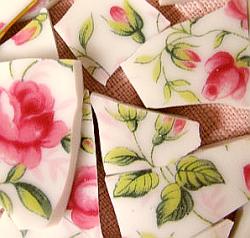
Many people desire to know which china patterns they have.
Some patterns are obvious like Royal Albert's "Old Country Roses" or Colclough's "Amoretta". These are popular classics and will always remain 'known'.
Some makers made a point of writing the name as part of the backstamp, others did not.
Some patterns have names, some just numbers. Many remain unidentified, now lost.
There is a way to research online which may make your life easier. That is what this page is about.
Surely There Must be Surviving Archives?
Before you set out, just bear in mind your task is made more difficult by the sheer weight of numbers - countess thousands of patterns produced over time by many hundreds of manufacturers.
Information is scarce and disjointed.
Pottery museums held some archives, but museums are becoming less well funded and less accessible to the public.
Most of the older manufacturers have long since gone into administration and exist now only as 'brands' of holding companies with much of any remaining production being done in the Far East.
This is true even of Wedgwood although they are still nominally functioning from Barleston, their ancient home. They used to have staff to help the public with enquiries. No longer.
In the UK, Worcester has gone, so has Spode. The Royal Doulton brand is part of the Wedgwood holding company, as are Royal Albert, Minton and many of the other old famous names.
Same with the old makers in the US and Europe.
There is an online club called the Transferware Collectors Club. I can't vouch for what information they hold as I am not a member. Anyway, not everyone cares to pay for a membership just on the offchance there may be some useful information.
So Who Actually Cares?
So, think in these terms.... who actually cares about your old china patterns?
Certainly not the executives of the holding companies.
Maybe some of the old auction houses that remain have records, but the experts who hold the records are unlikely to want to talk to you about your pattern research.
The picture is bleak, whichever way you turn, but there are still ways to research.
The China Pattern Research Action Plan

One online option is the service of replacements.com
This service does not cost money, but they are a commercial concern, wanting to sell you their inventory. I will go over their online service shortly, but first let's see what the other options are.
You may be happier with trying to get hold of specialist pattern identification books from the library.
Two top specialist reference books cover the identification of china patterns, and they are fairly easily available in libraries.
Library Research
There are two books I know of on the subject of researching china patterns (if you know of others, please write in tell me). Both are available in the US & UK, both in libraries.
They are:-
English Transferware: Popular 20th Century Patterns (Schiffer Book for Collectors) by Joe Keller and Mark Gibbs
and
Miller's Encyclopedia of British Transfer-Printed Pottery Patterns 1790-1930 by Gillian NealeWorldCat.org, enables you to track down the nearest library holding a copy of each book.
Instructions:-
- Go to WorldCat.org- Place the book title in the search box
- Click on a title in the results
- Scroll down to the 'library' function
- Put in your country into the library search box
- The results will show in a list format. Results:-
In the UK, the first title 'English Transferware: Popular 20th Century Patterns' is located in the Library of the Victoria & Albert Museum. In the US, this book is located in 36 different locations.
The second book - 'Miller's Encyclopedia of British Transfer-Printed Pottery Patterns 1790-1930' is located in my local main library as well as about a dozen or so other main libraries throughout the UK. In the US it is in 60 fifferent locations.
Online Resources
Now, getting back to the best free online resources to help you identify your pattern.
Replacements.com holds details of over 300,000 tableware patterns. They offer a completely free china pattern identification service. (Note:- I am in no way affiliated with this company)
The only restriction is if you want multiple patterns identified, they reserve the right to limit this service to their customers and suppliers.
The way round this is to go to their site yourself and have look around their online database of patterns.
- Go to their china section- Go to the name of your china manufacturer
- Look out for the vertical blue image bars on the far left of the page
- Click, then scroll down the images looking for your pattern
If you decide to send them a query, you must:-
- Take digital photos.
- Save them in JPEG format.
- Change to 72-100 DPI (low).
- Make them between 500 to 600 pixels.
- Photograph both the item and the pottery mark.
- Send the images by email to yourself first!
- This ensures they are clear
- Send research@replacements.com
Summary
Unless your pattern is a popular and well known one, you may have quite a task on your hands.
Think about using WorldCat.org and/or your local library to track down the specialist pattern-ware books mentioned above.
Otherwise, utilise the online pattern resources of online china retailers like Replacements.com