Pottery Mark - Royal Imperial F-handled Soup Plates & Saucers
by Corinne
(adelaide ,SA, australia)


Pottery Mark - Royal Imperial F-handled Soup Plates & Saucers
Pottery Mark Query - Royal Imperial F-handled Soup Plates & Saucers:- My mother was given this set of 5 handled soup dishes and saucers in 1955 as a wedding present. Despite extensive web searching, I can find little information on Royal Imperial, and nothing with this pattern.
I wonder if you could assist in dating these, and advise whether or not they were a commercially mass produced item, and hence of little value, or individually hand painted as she believes.
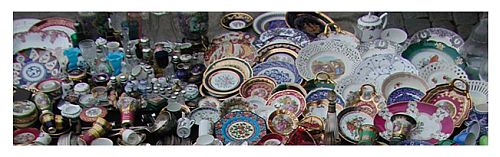
I was unable to get a clear individual photo of the marks, but it shows clearly in the group photo.
Royal Imperial in red, and has the letter F also in red underneath.
I am sure she would like some history of the company or details of the set if these were indeed a part of a dinner set.
I appreciate your assistance.
Corinne
===================================
Reply from Peter (admin) below - just scroll down
 |
Reply by Peter (admin)
To:- Pottery Mark Query - Royal Imperial F-handled Soup Plates & Saucers
Dear Corinne
Many thanks for your query and for becoming a friend to the site by subscribing to the newsletter.
It is an interesting query for many reasons, not least the story about your Mother’s insistence they are hand painted. Mother knows best, you know! Well mostly anyhow.
Firstly, I have never heard of Royal Imperial and they are not a famous maker as such - not a mention of them in any of my books. However, there are a few other makers who have used the name “Imperial” within their pottery marks (which I list below). To me, the name sounds like a made up name – possibly by a more recent firm who, in the 1950s, needed a trading name that sounded suitable for marketing bone china – possibly an off-shoot of a larger concern, or ex-employees.
Not many makers can legitimately use the word “Royal” in their trading names. One maker who held a proper Royal Warrant was the (now defunct) former giant of a company Ridgway.
Interestingly, the pottery mark on your Royal Imperial wares look almost exactly the same as various Ridgway pottery marks of the 1950s - similar oval shape with similar crown on top and bone china, made in England in the same places and a Red makers name in the middle. If it is a trade mark of Ridgway, why were they using a rather silly made up name of Royal Imperial, which means nothing, rather than one of their stable of at least a dozen or so famous historic backstamps? Who knows?
There is quite a bit of Royal Imperial bone china for sale on ebay, but I notice none of the sellers attempt to identify exactly who this maker actually is, because I doubt they know. If anyone knows, it would be great to have it identified here on this site, so please write in or leave a comment below.
Here are the other makers who use the name “Imperial” within their wares:-
- 1. There was a firm unconnected with Josiah Wedgwood, calling themselves Wedgwood & Co, who had many different trade marks for their wares. One such mark listed in my books is “Imperial Porcelain”. Another is “Royal Tunstall”, another is also “Royal Semi- Porcelain”. They are not
2. There was a firm by the name of William Hulme of Staffordshire who also used the name “Imperial Porcelain” for a short period of time in the 1950’s (but not identified as using “Royal Imperial”).
3. Two US firms used the term “Imperial” in their pottery marks. One was Hull Pottery of Crooksville OH, founded 1905, and the other was the Pioneer Pottery of Wellsville OH (1884 to 1900).
4. The Europeans also got in on the act with Imperial Wessel of Bonn (1893 to present) and Imperial wares by the Amphora Works, Bohemia (1892 to 1945)
Now the next interesting topic you bring up is the issue of hand painting.
Can an over-enthusiastic owner mistake hand painting for transfer print? Answer, YES, often.
Is it likely in this case? Answer, probably yes.
A slightly bogus sounding name of a modern firm like Royal Imperial would be unlikely to have dabbled in the highly expensive arena of hand-painted bone china, unless they were possibly quite mad and really wanted to go out of business fast. If it IS hand-painted you would have something unique and very rare, so treasure your collection. Hopefully Mum will prove me wrong!
How to tell if your wares are hand painted?
A transfer print can easily fool the eye because, of course, the original artwork is painted by a real person of great artistic talent. Sometimes tricky manufacturers can partly hand paint a finish and describe the wares as ‘hand-painted’.
First Look Up Close
A good magnifying glass is a must! Look at the areas of shading, for example, where a petal goes from light to dark – you will see the strokes of the brush before your very eyes. A transfer print will have fine dots, rather than brush marks. If in doubt, the best way to confirm printing rather than painting is to compare the same pattern on different pieces in the same set. On the printing it will be identical. On the painting of course it will be different each time.
Mixed techniques (part hand painted, part transfer) will have obvious transfer printed outlines, within which the painter ‘fills in the colour with glaze’.
Then Feel the Wares
Transfers are mostly done ‘overglaze’ (ie. over the top layer of glaze). There is a slight ridge where the print starts. Run your finger across to see.
Well that's my tuppence worth about your mystery soup dishes. If you can't wait for an answer via this public forum, or if you'd like some professional input, feel free to use my 'fast track to an expert' page
www.figurines-sculpture.com/id-pottery-mark.html
where you can contact a bona fide professional appraiser - one I’ve checked out myself - who can tell you if your mark is identifiable by experts without you having to pay any money upfront. This service is unique online and is designed to protect my site visitors from wasting their time and money online.
On my China Replacement page, I show you how to search the internet properly and find the value of your Royal Imperial wares.
I give general tips on pottery marks here .
Hope this helps!
Best regards,
Peter (admin)
Comments for Pottery Mark - Royal Imperial F-handled Soup Plates & Saucers
|
||
|
||
|
||
|
||
|
||
|
||
|
||
|
||
|
||
|
||
|
||
|
||
|
||
|
||
|
||
|
||
|
||
|
||
|
||
|
||
|
||