- Home
- Identify Pottery Marks
- Meissen Marks
|
🏺 Treasure or Trash?
Unsure about what you have? Send photos to me, Peter, for a quick free opinion.
|
Get Free Verdict → |
Meissen Marks: How to Date the Crossed Swords and Spot the Fakes
Meissen marks are the most famous, and most copied, in the porcelain world. The good news is that the crossed swords changed in small, telling ways over three centuries. Once you know what to look for, you can usually tell whether a genuine piece is antique or modern, and often date it to within a few decades.
And the vast majority of “Meissen” that turns up in homes isn’t 18th-century royal porcelain. A large share is 20th-century, and some isn’t Meissen at all.
Written by Peter Holland
Figurine master sculptor for Royal Worcester, Royal Doulton and Coalport, helping readers identify and decode pottery marks here since 2006
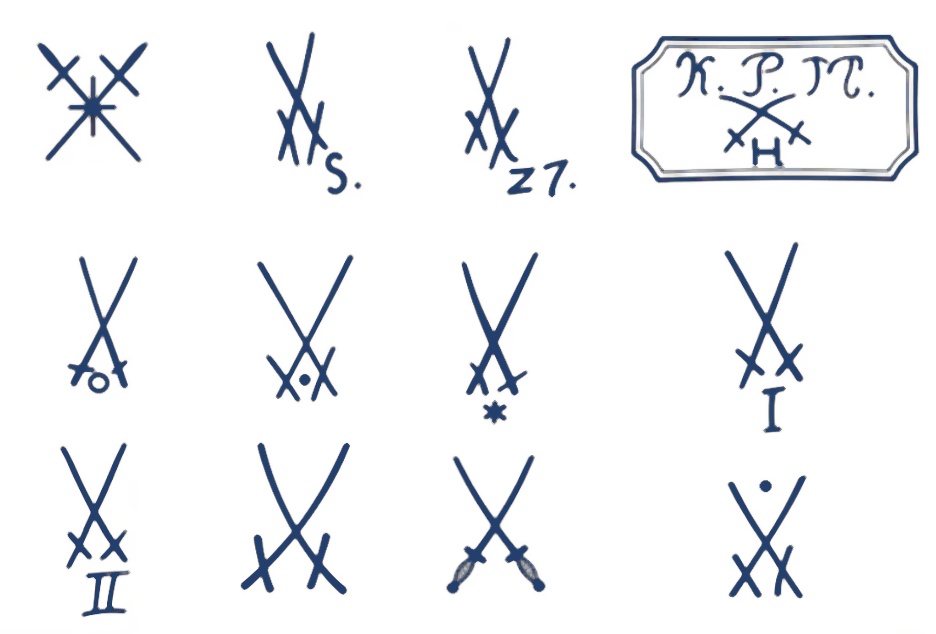 Identifying all these crossed swords Meissen mark and more
Three Things to Check First
- Is it really Meissen? Genuine marks are hand-painted in underglaze blue, under the glaze, not printed on top. Crossed swords were copied by dozens of other factories and decorators. See Is it really Meissen? below.
- Antique or modern? Compare your swords with the table below. Look for dots, stars and knobs on the hilts.
- Any cuts through the mark? One or more scratched lines through the swords mean the piece was sold as a second. See Seconds and cancellation cuts below.
Date Your Crossed Swords at a Glance
Notes on the Meissen Marks Table:
- Meissen crossed swords marks were painted in the factory by hand. They vary quite a bit.
- The followng are broad guidelines for each era, but not definitive.
- Be aware that mark era changes crept in gradually, there is overlap.
- If the marking doesn't follow the broad rules shown here, just take time to look extra-closely into glaze and style etc.
- Online, different charts give different dates for when each mark era changed because even respected reference books and databases disagree.
- Some date the pommel sword marks from 1815, others from 1850 or 1860.
- I follow the dating used by German Meissen specialists (ie 1850 not 1815 for the pommel mark).
The table below shows images redrawn for illustrative purposes and are not actual marks.
| Your Mark | Period | What the Swords Look Like | Dates |
|---|---|---|---|
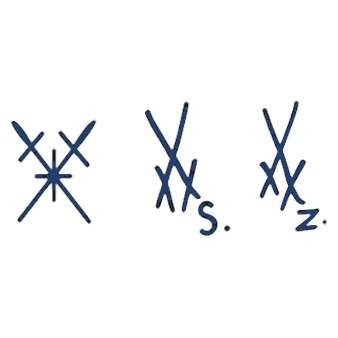 |
Early swords | Early hand-painted swords in many variations, sometimes with painter or gilder initials or numbers below | c.1724–1763 |
 |
Dot Period (Punktzeit, also called the Academic Period) | A dot between the sword hilts | 1763–1774 |
 |
Marcolini Period | A small star between or just below the hilts | 1774–1814 |
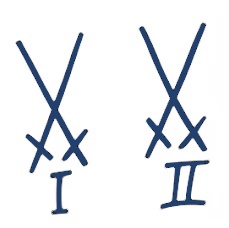 |
Transitional years | Swords often with straight hilts sometimes with the Roman numerals I or II alongside | c.1814–1824 |
 |
"Smear period" (Schmierperiode) | Plain hilt ends, often carelessly painted and smudged; easily mistaken for an 18th-century mark, but often noticeably smaller than previous or later periods. | c.1824–1850 |
 |
Pommel Period (Knaufzeit) | Round knobs ("pommels") at the hilt ends. Blades can be straight, or curved in either direction slightly. | c.1850–1924 |
 |
Pfeiffer Period | A dot between the sword tips (not the hilts, unlike 1763–1774). Tending towards a subtle curve on the blade, but not always. | 1924–1934 |
 |
Modern swords | Plain, slender crossed swords with no dot, star or knobs. Curving of the blade is seen to be continued. | 1934–2018 |
 |
Current mark | A slightly refined version of the modern swords. The blade curving is kept and subtly modified. | Since 2018 |
Smudged Swords: 1830s or 1730s?
A carelessly painted “smear period” mark (c.1824–1850) can look old, but the piece usually gives itself away:
- The porcelain: 19th-century paste tends to be a cool, bright, even white. Early 18th-century paste often has a warmer, creamy or faintly greyish tone, with tiny firing specks.
- The foot rim: 19th-century bases are usually neat and smooth. 18th-century ones show more hand-finished irregularity.
- Impressed numbers: Crisp, standardised mould and former’s numbers pressed into the base point to the 19th century or later.
Antique or modern? The quick rule
Antique or modern? The quick rule: knobs on the hilts, a dot or a star mean the piece was made before 1934. Plain swords usually mean after 1934, but plain swords were also used around 1814–1850. To tell those apart, look at the style of the piece, the glaze, and the base: since 1948, Meissen has pressed a small year symbol into every piece, usually alongside a painted pattern number and a red painter's number.
Seeing letters such as K.P.M. or AR instead of, or with, the swords? These are rare early marks, and much copied so if you have this, do not get too excited.
Every Meissen mark is painted by hand, so no two are identical, and reference books don’t always agree on exact dates. Use this table as a guide, then check that the painting, glaze and modelling all fit the same period. Also be aware that these drawings show the shape of each period’s swords, redrawn for clarity and because the marks are hand painted in cobalt blue under the glaze, expect slightly uneven strokes and a little blurring where the blue has sunk into the glaze. A perfectly crisp, uniform mark is a reason to look more closely, not less.
Is It Really Meissen? The Look-Alikes
The crossed swords may be the most imitated mark in porcelain. Meissen itself says only authentic Meissen carries the swords, painted by hand in underglaze blue since 1722. So the first question is always whether the swords are Meissen’s at all.
Hand-Painted or Printed?
Genuine Meissen swords are painted by hand, and that leaves clues:
| Genuine Hand-Painted Meissen (Underglaze) | Printed or Transfer Copy |
|---|---|
| Strokes vary in thickness | Even, uniform lines |
| Soft edges, slight blurring into the glaze | Sharp, crisp edges |
| Under the glaze: smooth to the fingertip, can’t wear off | Often on top of the glaze: may feel slightly raised, or show wear |
| Each mark slightly different | Identical from piece to piece |
These are rules of thumb, not guarantees, but a perfectly crisp printed mark on top of the glaze is a strong warning sign.
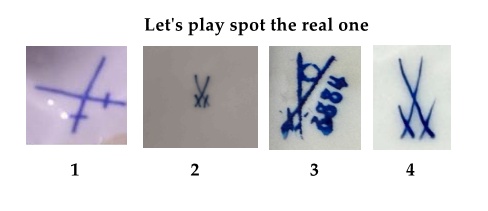
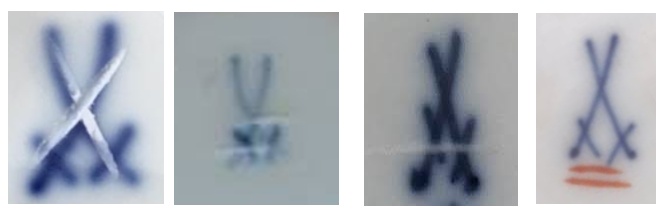
Visitor Challenge:
Ok,the challenge is to look at the four images above from the China Chat forums and try to figure out wich one is the real Meissen mark.
Answer:
Two of them are obvious fakes (1 & 3). The choice is 2 & 4.
Just from the mark, the swords painting on no.4 is almost too sharp in terms of brush size. Not conclusive in itself. Looking at a close up of the photo it looks like it might be overglaze - hard to tell. However, other clues of the hand painting and gilding on the cup and saucer, toghether with its style. tell us a whole load of information, as follows:
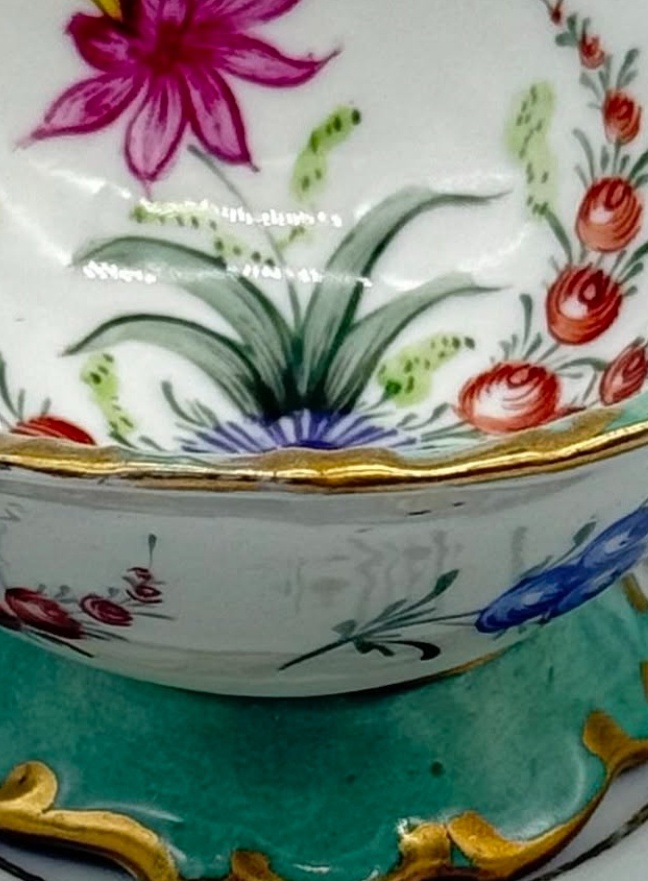
The Ground Colour & Gilding on mark no. 4's cup & saucer: The bright turquoise/verdigris ground is mottled, sponged/washed texture framed by heavy gilding. True Meissen tends to lay more evenly & delicately. This bold, thick, slightly lumpy gold relief is classic 19th-century Historicism / Neo-Rococo revival work. The floral painting style is definitely hand-painted but the handling is loose, rapid, and commercial-revival in character. The form & moulding are exaggerated 19th-century "Rococo Revival" (Zweites Rokoko) silhouettes.
So the mark might fit the smear period at a pinch, but the form and decoration point to a later decorative revival piece rather than the earlier 18th-century "Smear Period".
Number 2 is the right answer.
Reality Check: Before You Call the Auction House
Finding an interlaced AR or a cursive K.P.M. on the base is exciting. But in real-world detective work, the vast majority of pieces with these marks found in homes today are not 18th-century royal Meissen.
The Wolfsohn trap. In the late 1800s (roughly 1860–1900), Helena Wolfsohn’s Dresden decorating workshop painted thousands of pieces with underglaze blue AR marks in tribute to early Meissen. After legal action from Meissen in the 1880s over the AR monogram, she moved to a crown over a script D. That’s distinct from the 1883 crown-over-“Dresden” mark associated with the four decorators’ arrangement (see my German & Bohemian marks page). Wolfsohn was a decorating studio, not a porcelain maker, and later imitations of her marks exist too. Genuine Wolfsohn pieces are handsome and collectible in their own right, but in a completely different value bracket from royal Meissen.
The K.P.M. confusion. A K.P.M. mark found today almost always belongs to the Royal Porcelain Manufactory in Berlin (KPM Berlin, a royal factory from 1763, usually with a blue sceptre mark), or to later makers such as Krister in Silesia. It’s very unlikely to be Meissen’s very rare K.P.M. mark of 1723–1724.
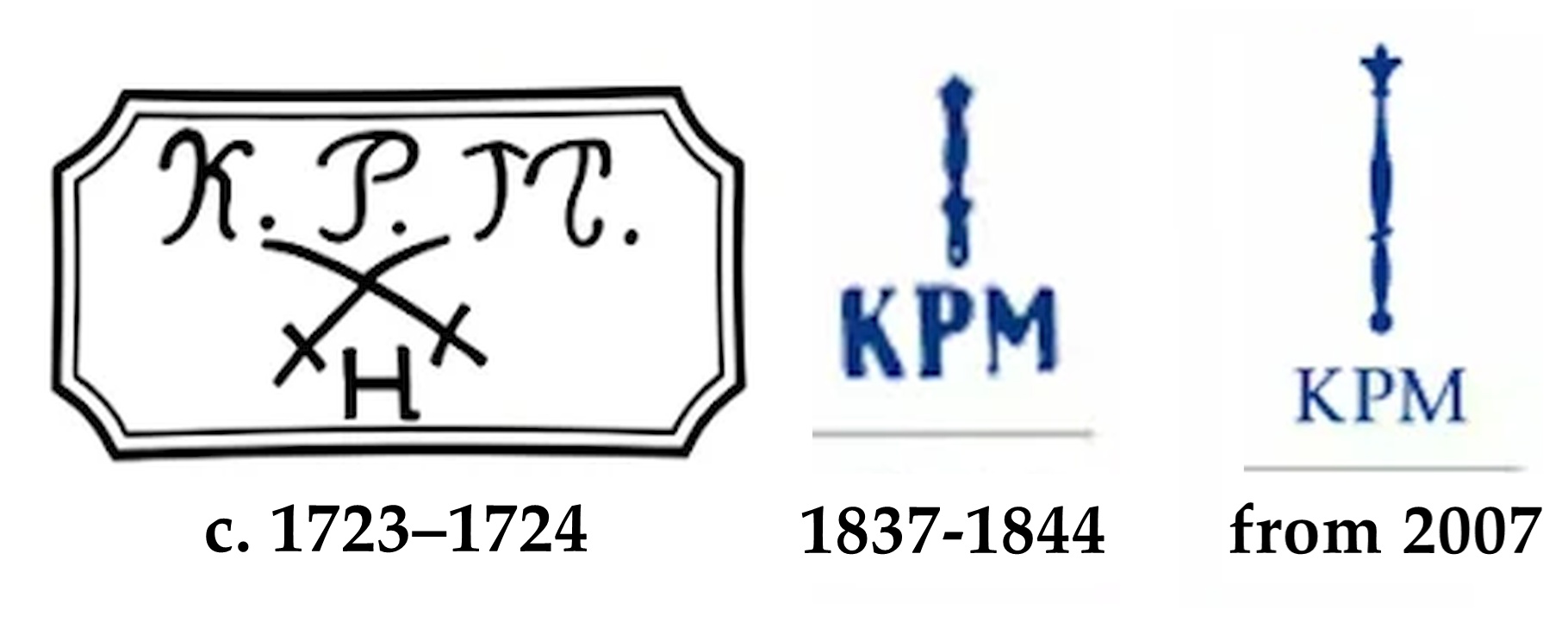 Meissen’s rare K.P.M. mark (left) and the far more common KPM Berlin sceptre mark (middle) and the modern version (right)
Factories That 'Borrowed' the AR Mark - 1725 or 1890?
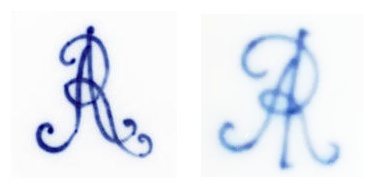 Real mark c. 1730 (left) - Dresden mark c. 1890 (right)
How to tell the difference: in a photo, an 1880s Dresden AR mark and a 1725 Meissen AR mark can look deceptively alike. Separating a genuine early piece from a 19th-century revival mainly comes down to the paste, foot-rim wear, glaze pooling and brushwork together, not the mark on its own. For a detailed breakdown of how to do this, go to this thread where I look at all those details: more on the Helena Wolfsohn AR mark court case story in this thread. In this China Chat thread I look at the historical context of the AR Mark and how the 19th Century European decorating studios got around the cease & desist orders after the Meissen vs Wolfsohn court case c.1883.
Factories That 'Borrowed' the Crossed Swords
- Samson of Paris: the most famous maker of imitations of Meissen and other historic factories, in the 19th and early 20th centuries. Samson marks usually differ subtly, sometimes with an S. Once recognised, Samson pieces are collectible in their own right.
- Carl Thieme, Potschappel: crossed lines or swords with a T above, from Thieme’s factory near Dresden, from the 1870s. Known for ornate decorative figures.
- Sitzendorf, Thuringia: crossed lines, used in the late 19th century alongside its better-known crowned S marks. Very common on figures and groups.
- “Dresden” crown marks: a crown over DRESDEN, often with GERMANY. The word “Germany” points to the late 19th or 20th century. “Dresden” here means a style and trade name, not one factory.
- Lesser-known crossed-line marks: old reference books attribute various crossed-line marks to Coburg, Meyers & Sohn, Hirsch, Müller and others. Treat these as leads to check, not proof.
For more copies, including the chain from Bing & Grøndahl to Carl Schneider to cheap Japanese imports, see Copies and look-alikes on my German & Bohemian marks page, and Real or Fake? Pottery Marks Copied and Faked.
Seconds and Cancellation Cuts: Scratches Through the Swords
Look closely at the swords under a good light. A short line ground or scratched through or beside the mark means the piece left the factory as something less than first quality. It doesn’t make it a fake, but it does lower the value compared with a clean, first-quality mark.
What the Cuts Mean Today
This is Meissen’s own current scheme:
| Drawing | What You See | Meaning |
|---|---|---|
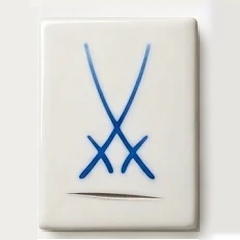 |
A short cut beneath the swords | Second grade |
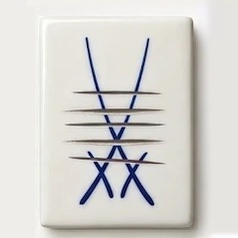 |
Several cuts across the swords | Faulty ware |
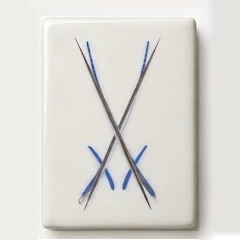 |
Two cuts crossing through the swords | Broken (damaged) ware |
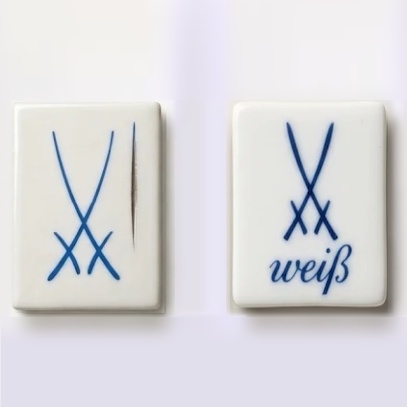 |
A short cut beside the swords, or the word weiß (“white”) beneath them or on its own | Sold undecorated, as plain white porcelain |
Sources: Meissen: "Recognise originals" and Meidabank: markings and numbering of Meissen porcelain.
On Older Pieces, Read the Cuts with Caution
Before the modern scheme, practice was less consistent, and reference books don’t agree. Older guides often say a single cut meant a piece sold undecorated (“in the white”), and several cuts meant faulty stock. German sources describe a fuller system: two cuts for second choice, three or four for lower grades sold to factory staff, and five, or two crossed cuts, for pieces kept for factory use.
So on an older piece, treat any cut as a sign of a second, without reading too much into the exact number.
One extra check: a cut on a piece sold “in the white” can mean the decoration was added later, outside the factory. If a cut piece is lavishly painted, look carefully at whether the painting matches Meissen’s quality. The same applies if you see orange underscore marks - not meant as seconds or faulty, but may indicate decoration specifics or studios.
The Rare Early Marks (and Why You Probably Don’t Have One)
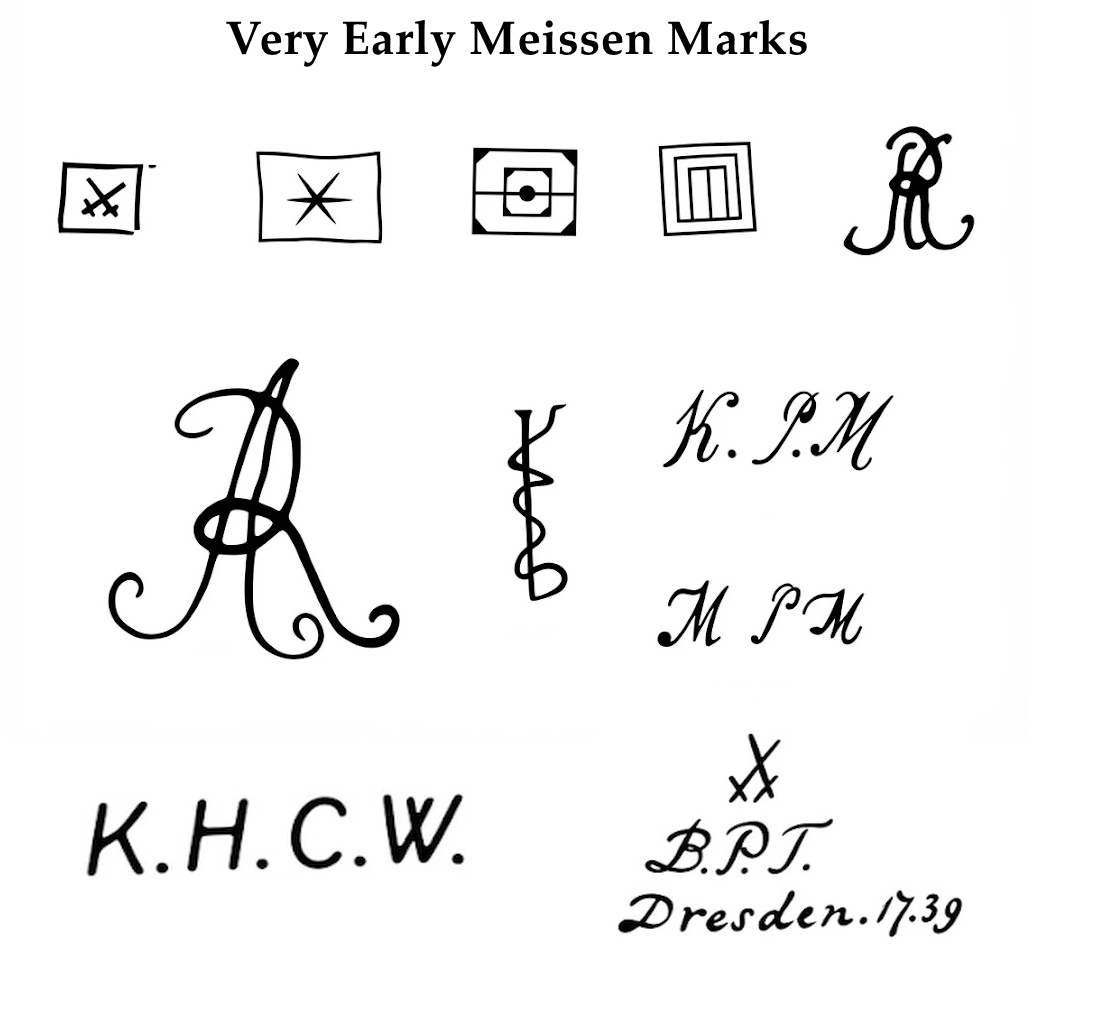
Before the crossed swords became standard in the mid-1720s, Meissen used a handful of other marks. Genuine examples are rare, mostly in museums and major collections, and nearly all are much copied. Read this section for interest, and if you think you’ve found one, read Is it really Meissen? above before getting your hopes up.
Böttger Stoneware Marks (c.1710–1720s)
Tiny impressed marks, such as crossed tools or a six-pointed star in a small square, stamped into Johann Friedrich Böttger’s dense, unglazed red stoneware from Meissen’s first pioneering decade. They identified individual moulders or workshops.
Pseudo-Chinese Marks (c.1720–1725)
Before Meissen had its own identity, its painters copied Chinese square marks and symbols in underglaze blue on chinoiserie wares. On genuine pieces, the brushwork looks a little loose and experimental, not like a rigid later print.
The AR Monogram: Augustus Rex (c.1722–1735)
Interlaced initials in underglaze blue for Augustus the Strong, Elector of Saxony and King of Poland, who founded the factory. Genuine AR pieces, often with rich Kakiemon or chinoiserie decoration, were made for the royal palaces or as diplomatic gifts, not for sale. This is the most faked Meissen mark of all; see the Wolfsohn trap above.
The Caduceus (c.1723–1730)
A staff entwined with a serpent, the staff of Mercury, painted in underglaze blue. It was used mainly on porcelain for export. One common explanation is that some overseas merchants objected to the crossed-swords symbol. It’s occasionally seen alongside early swords.
K.P.M. and M.P.M. (c.1722–1724)
Cursive initials in underglaze blue: M.P.M. (Meissner Porzellan-Manufaktur) briefly around 1722–1723, then K.P.M. (Königliche Porzellan-Manufaktur) around 1723–1724. Early handbooks claimed K.P.M. appeared only on teapots, stands and sugar boxes, but surviving examples include cups, saucers and bowls. A rare transitional version combines K.P.M., early crossed swords and an initial in a double-lined frame.
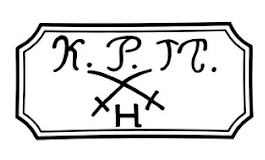
Remember: a K.P.M. mark found today almost always means KPM Berlin, not Meissen.
Court Marks (c.1725–1740s)
Some early pieces carry inscriptions showing where they were used:
- K.H.C.W. (Königliche Hof-Conditorei Warschau, the Royal Court Confectionery in Warsaw), for porcelain supplied to Augustus’s court in Warsaw. Older books often misprint it as K.M.C.W.
- Rarer palace and service inscriptions, some still debated by specialists.
Court marks were copied on later pieces too, so always weigh the mark alongside the paste, glaze and quality.
Five Meissen Mark Myths, Corrected
Many Meissen “facts” get copied from book to book and site to site. Here are five you’ll often meet, and what’s really true.
| The Myth | The Truth |
|---|---|
| “Crossed swords mean Meissen.” | Not always. Dozens of factories and decorators used crossed swords or crossed lines, from Samson in Paris to Thuringian makers and Japanese importers. Genuine Meissen swords are hand-painted in underglaze blue. |
| “Dresden and Meissen are the same thing.” | No. Meissen is a single factory near Dresden. “Dresden” porcelain usually means work by the city’s many independent decorating studios, who bought in white porcelain and painted it in Meissen-like styles. |
| “An AR mark means royal 18th-century Meissen.” | Rarely. Most AR-marked pieces found today are 19th-century tributes, many from Helena Wolfsohn’s Dresden studio. Genuine AR pieces were made for the royal palaces and are museum rarities. |
| “K.P.M. is an early Meissen mark.” | It was, very briefly, around 1723–1724, and survivors are extremely rare. A K.P.M. mark you find today almost always belongs to KPM Berlin, usually with a blue sceptre. |
| “One cut through the swords means it was sold undecorated.” | Only sometimes. In Meissen’s current scheme, a short cut beneath the swords means second grade, and a cut beside them means sold in the white. On older pieces, practice varied and books disagree. |
The golden rule: no single mark proves anything on its own. Always read the mark together with the porcelain, the glaze, the painting and the modelling.
Real or Fake? Look Beyond the Mark
A mark can be copied in minutes. The craftsmanship behind genuine Meissen can’t. As a former figurine modeller for Royal Worcester, Royal Doulton and Coalport, these are the things I look at before I even turn a piece over.
- The modelling. Genuine Meissen figures are modelled with crisp, sharp detail: separated fingers, individually expressive faces, flowers built petal by petal. Copies taken from tired moulds look soft, as if the detail has slightly melted.
- The assembly. A Meissen figure is assembled from many separately moulded parts, with the joins skilfully hidden. Cheaper copies use fewer parts, and the mould seam lines are often still visible.
- The painting. Look for fine, confident brushwork, delicate faces and shading. Coarse, flat colour, or decoration that looks printed, is a warning sign.
- The porcelain and glaze. Check that the paste and glaze fit the period the mark claims. See Smudged swords: 1830s or 1730s? above.
- The base. The swords should be painted in underglaze blue, not printed on top. Look for impressed model numbers, and on post-war pieces, the small impressed year symbol used since 1948. Check whether the foot rim is finished neatly.
Put together, these clues usually tell the story. If they don’t all point the same way, the piece needs a closer look by someone who has handled the real thing.
Not sure? Send me photos of the piece and its base for a free first opinion: Treasure or trash? Send photos →
.