- Home
- Antique China Values
- Value of Antiques
Value of Antiques: Score It, Research It, Know What It's Worth
Find the value of antiques and old china with my 7-box ready reckoner (below), then check real sold prices in the online price databases most people never hear about. This is exactly how I teach people to make money from bits and bobs of old china. They learn to instantly judge what they are looking at, and allocate it a 'valuation band score'. This page lets you do the same with your own pieces — china or any other antique. If you have china/porcelain I'll help with a free first opinion too if you need it.
MASTER VALUATION GUIDE
In This Comprehensive Guide To The Value Of Antiques & Old China:
- Score it in two minutes: the 7-box ready reckoner (tick-box tool)
- What each box really means: age, condition, quality, design, fashion, rarity, notability
- The hidden rules: when condition & rarity change the score
- Worked examples: How Real pieces score on the Ready Reckoner Tool
- Research it yourself: the auction and sold-price databases I use
- Mark identification websites to find out what you have in the first place
- Or just ask me: send photos for a free treasure-or-trash opinion
Introduction:
You can get an idea of the value of antiques by beginning to think a little differently. In this post I'll show you exactly how.
Typically, people inherit some china from Gran, they wonder if it's treasure or trash. It's probably somewhere in between. Before you decide whether to chuck or sell (on Ebay, Etsy, Facebook Markets, Craigslist, replacements websites or saleroom auction), try to stop for moment, look at your item closely and see which boxes it ticks.

To know the value of antiques and fine china, you need to start thinking differently!
How? You need to start thinking in terms of categories of pricing bands based upon 'The 7 Simple Stipulations' (or categories) of.....
AGE - CONDITION - QUALITY - DESIGN - FASHION - RARITY - NOTABILITY
1. Score It in Two Minutes: the 7-Box Ready Reckoner Tick-Box Tool
 Let's tick some boxes guys!
Auto Ready Reckoner: Tick-Box Calculator Done For You (Single Items)
Check off the box categories your item satisfies and see your estimated price band auto-calculate below (rough-reckoner only! - if you need my personal help go here:
Complete multi-piece sets follow a different set of rules. While a pristine, fully intact 19th-century service commands a major "completeness premium," a single missing component or mismatched piece can alter the math entirely. Drop me a message with photos of the full set here and I'll help you untangle it.
Mastering the ready-reckoner: - when not to apply it
While the Ready Reckoner framework offers a guide for how to think about the value of antiques, many heirlooms, real-world antiques and fine ceramics don't always follow this linear script (neither do sets), so exercise caution and use the reckoner as a rough indicator only. Certain market factors act as powerful multipliers, or devastating penalties that override simple box-ticking.
2. What each box really means: Deep Dive Into How the Categories work
Box #1. AGE
There can be a difference in value say, between antique and vintage. Antique tends to fetch more. However, don't forget, they made inferior stuff back in the day, too.
But how do you know just by looking at it whether it's old or not, and if so, how old? Well, using logic, look at the evidence. Where did this piece come from (they call this 'provenance' - which is a fancy term for origin, history and ownership). Was your Gran a knowledgeable collector? Did the thrift store/charity shop not realise what they had? Was there a lost treasure in the car boot/garage sale?
The likely answer is that it's much more likely to be vintage than antique - there's just more of that stuff around - most of it run of the mill.
Most older antique items that tick several boxes give themselves away just by looking at them. There is time and skill spent on the shape, decoration and finish. Valuable old stuff tended not to be knocked up for mass production and a quick buck. Exceptions being Staffordshire flatbacks and Victorian fairings. However, those items still give themselves away by being .... well, cute to look at - they tick several other boxes other than age.
Box #2. CONDITION
Condition matters for the value of antiques. Collectors pay for tip top condition. No damage, no chips, minimum wear and tear. So this box matters. A damaged/worn item is worth way less than a pristine item. Don't try to know the value of antiques without giving them a proper eyeballing first.
Condition is unique amongst the factors because it isn't just a bonus, it is a divisor — in that any crack, chip, fading or restoration strips value away like a solvent. In the professional market, no serious person will fail to look for faults. The same applies to seconds. Your item drops down several price bands if an issue is detected.
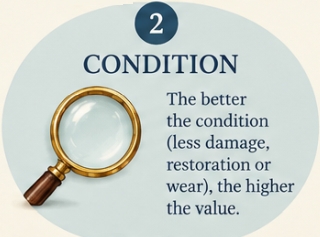
Box #3. QUALITY
Just think how much skill, time, engineering, artistry, cultural identity, and political backing that went into the making of a Qing vase. No wonder they reach top prices. They are clearly one of the peaks of human achievement in any field let alone ceramics.
Think about this when you consider quality and work down from there. How much pure unadulterated craftsmanship do you see in the piece you are looking at? Does your item have a few slapped on swipes of paint that looked like it was whacked on in a production line under mass-production time pressure done by someone who feels like they need a well earned break soon?
I have sat for hours on end in the same room (studio) as renowned Royal Worcester artist/painters carrying out their skills. Believe me, these people are cheerful, considered, proud of what they do and happy to be there. It shows in the work - because it's not work to them. Is the item transfer printed with a gorgeous piece of artwork, again produced by a specialist transfer print artist? This evaluation is not auction snobbery, it's just a way to get you to think about what quality means - and knowing it when you see it. This is perhaps the essence of knowing the value of antiques.
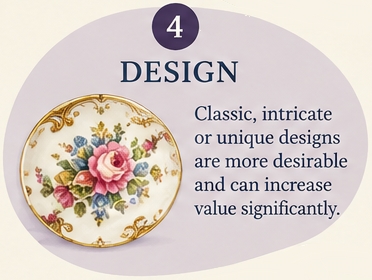
Box #4. DESIGN
So, with this category, a little design quality can go a long way. For an example, just look at the designs of Clarice Cliff or Susie Cooper. They were in league with fairly run of the mill earthenware makers yet their wares became sought after. They had a voice in the organisation and were able to have their way.
Shelley, Tuscan, Franciscan and Paragon to name but a few were makers who prided themselves on their design values and so their values tend to hold up, even when times when china is out of fashion. Here's a clue, the designers were in charge of the aesthetics, not the accountants.
Ask yourself this: Does your item look like it was the pride of a designer's eye, or was an accountant behind it?
Box #5. FASHION
Speaking of fashions, there will always be the ebb and flow of contemporary tastes which put a premium on prices. Just the opposite if the thing is deemed to be Grannie's trinket.
Bear in mind though, just at the moment when the general public is putting the most hate onto old stuff, the fashion police are just beginning to take a second look. Just saying... Take a second look at these here boxes before you get a bit premature and throw out the wrong thing just as it's becoming right. Fashion is always a factor in how to understand the most up to date value of antiques.
Box #6. RARITY
Well, now here's one of the most important boxes in terms of getting to grips with the value of antiques. It can override most of the others in a single bound. Yes, it's a super-box, but only when combined with the next box #7 Notability.
So, how do you know if something is rare? Well, look it up on the greatest database ever available to mankind - the internet. Describe what you see in your own words and use lots and lots of search term variations. If you do this and find nothing, then your item is rare.
However, something can be rare and old for that matter, but if it's not sought after by any kind of enthusiastic group of avid collectors, then it doesn't have much of a monetary value. I say monetary because, it may well be extremely interesting and even tick a couple of other boxes like age, condition and quality, but if it has no eminence, then it doesn't have monetary value.
Box #7. NOTABILITY
Notability is defined as 'the state or quality of being eminent'. So this is the other super-box, possibly the single most important in understanding the value of antiques. All the others are important of course, but the last two are make or break with regard to monetary value.
A great example of how this works is that until 1911, the general public had not really heard of the Mona Lisa by Leonardo Da Vinci. It was just another small (but amazing) renaissance painting in another big art gallery. But then one day in 1911, it went missing. There was an uproar and the publicity lasted years, until it was found and the thief put in prison. That notability never went away.
Today, for reasons other than the painting's brilliance it is a shining beacon for art and the value of it. Had the theft been of another painting, the Mona Lisa would be unlikely to have such pre-eminence. The takeaway here is that some stuff becomes eminent due to accident, or by ticking a few of the above boxes and people get to hear of it. There naturally follows enthusiastic and avid collectors - who are willing to pay top dollar.
3. The Hidden Rules: When Condition & Rarity Change the Score
1. The Condition Penalty
Box #2 (Condition) is unique because it isn't just an additive bonus, it is a game changer. A hairline crack, a chipped rim, or clumsy amateur restoration acts as a big down-valuer. In the professional market, serious collectors pay premium prices specifically for pristine examples.
2. The Rarity & Notability Synergy (The Super-Box Combo)
In the Ready Reckoner, Box #6 (Rarity) and Box #7 (Notability) are what we call "Super-Boxes". Scarcity alone does not create monetary value; if an item is extremely rare but nobody knows about it or wants it, it remains an obscure curiosity. However, when high rarity meets active collector demand (eminence), prices don't just increase—they skyrocket.
The Synergy Rule: Ticking both Box 6 AND Box 7 simultaneously triggers the higher values. If you have checked both of these boxes, it automatically bumps your calculated result up.
4. Worked Examples: How Real Pieces Score on the Ready Reckoner Tool
Important note (disclaimer):
The ready reckoner is a rough subjective starter guide only, and subject to personal opinions and preferences. Two people might score the same item completely differently and they would argue about it all day. However, this is precisely why auction prices differ so much - both from auction to auction, and from estimate to estimate.
The following are examples from actual auction results and the reasons for which boxes were ticked are given. These are my own personal opinion, but they happen to coincide with the auction prices.
Real Auction Sales Results
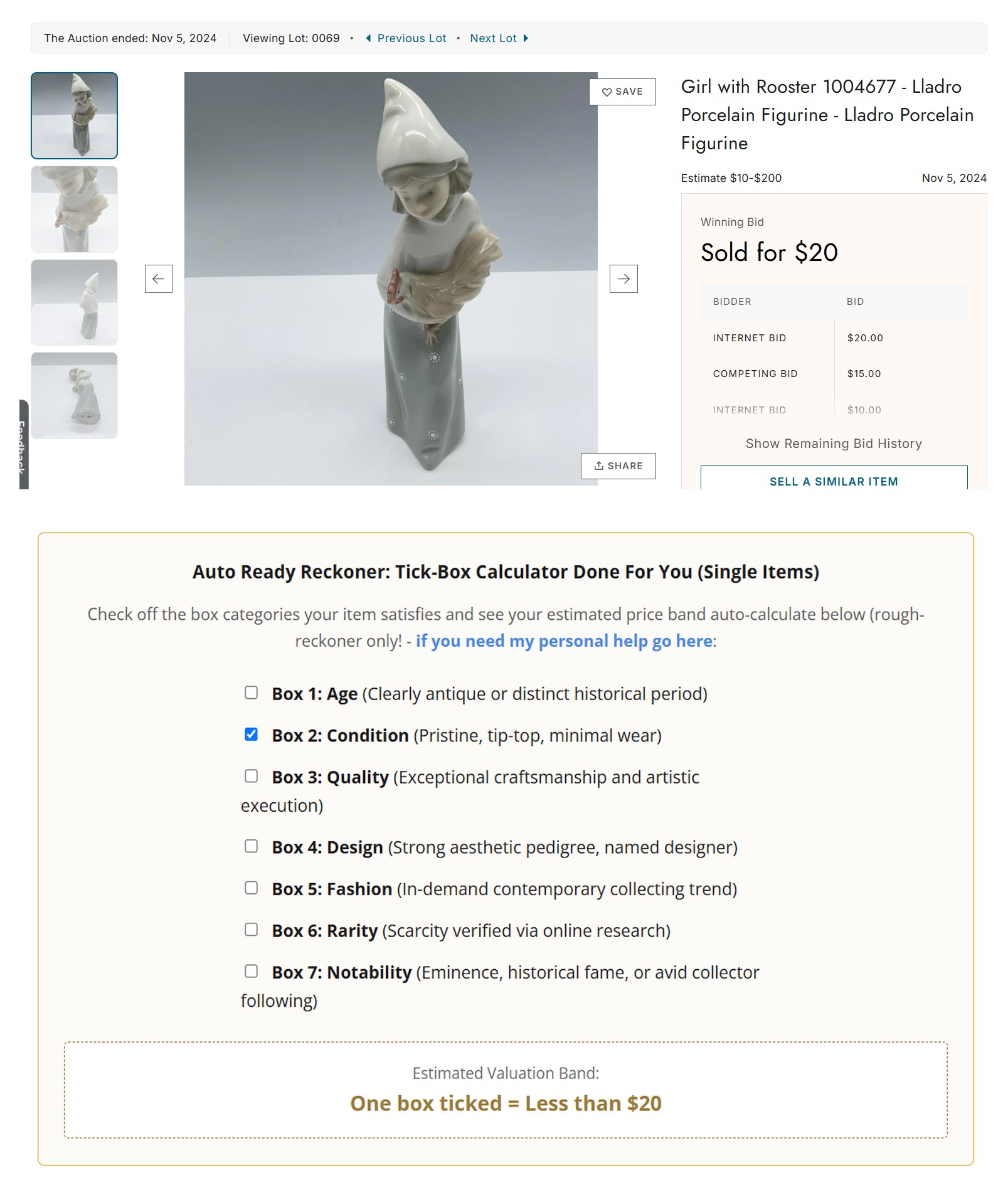
Example 1: $20 or under (one box ticked)
 Photos from the Liveauctioneers.com database
Small Lladro girl figurine with a chicken - why one box ticked?
Note, this piece is branded (Lladro), so it's sitting on the top end of this category and could easily be in the next band. I hear people say, "hang on, Lladro is a well regarded, famous and collectible brand", why aren't we ticking box no. 4 - 'Design'?". All true. This box is not about great brands, it is about creme-de-la-creme elite pedigree or famous person. Do not mistake the two. Another Lladro piece might tick more boxes, but not a little production roll-out cutie like this.
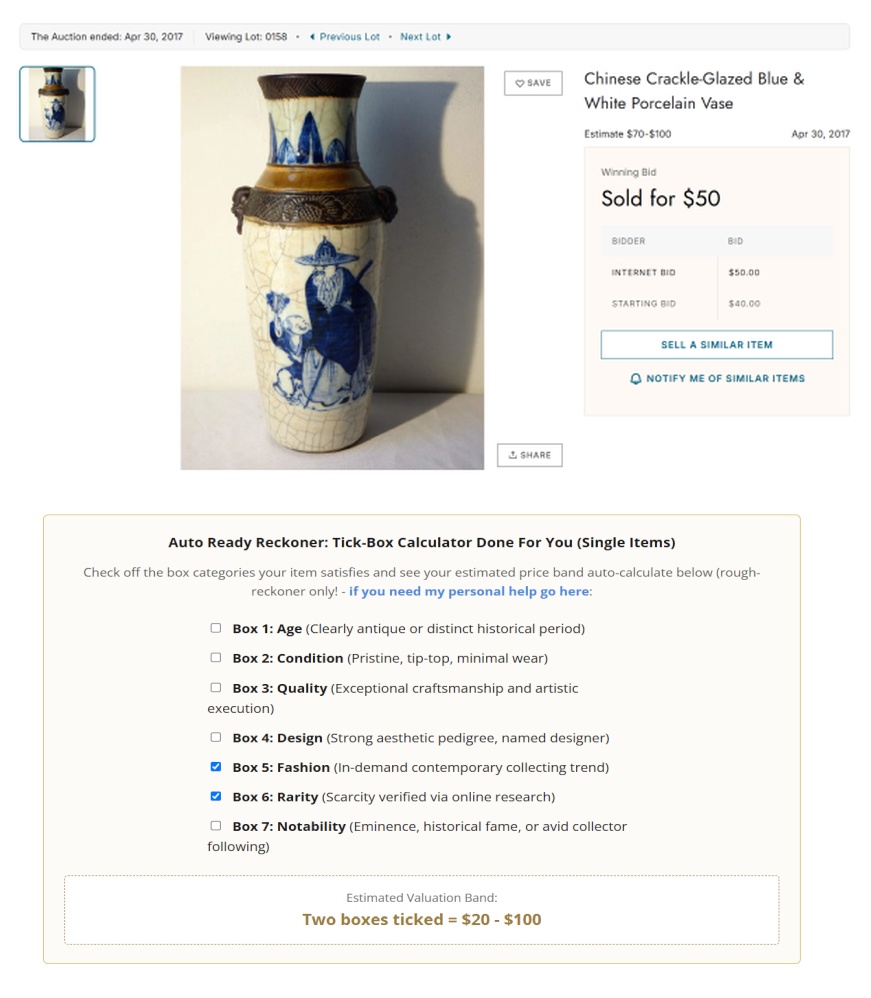
Example 2: $20-$100 (two boxes ticked)
 Photos from the Liveauctioneers.com database
Chinese crackle glaze vase- why two boxes ticked?
This vase sold for a modest $50 because it is a modern decorative reproduction rather than a genuine, high-quality antique. It is modern, fashionable and attractive to those wanting a certain type of look, but it lacks the age, exceptional craftsmanship or the rarity of true imperial or period Chinese porcelain. It ticked the scarcity box only because - even though there are lots of these types of faux ancient Chinese vases around - if a person had a particular liking for this exact design, it would be hard and time-consuming job for them to track it down on the secondary market.
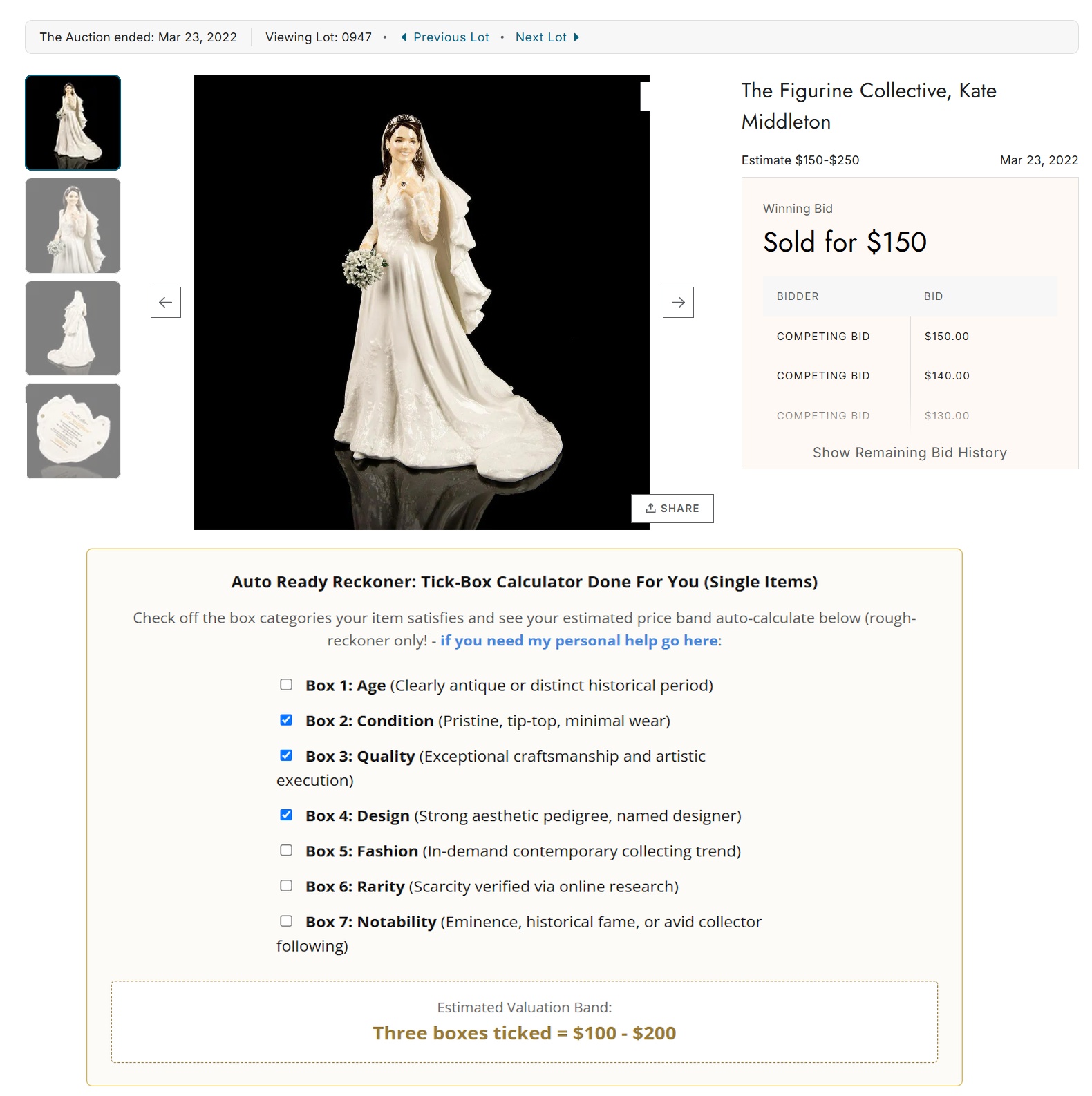
Example 3: $100-$200 (three boxes ticked)
 Photos from the Liveauctioneers.com database
John Bromley's Kate Middleton - why three boxes ticked?
The $150 is an average price for this at auction. It is a product of a well known artist with a collectible aesthetic, and hand made by specialist English bone china artisans. The other boxes it doesn't currently tick, being made around 2011 and apart from that, it isn't fashionable enough, rare enough or notable enough to tick the remaining boxes. It may be different in the future, watch this space.
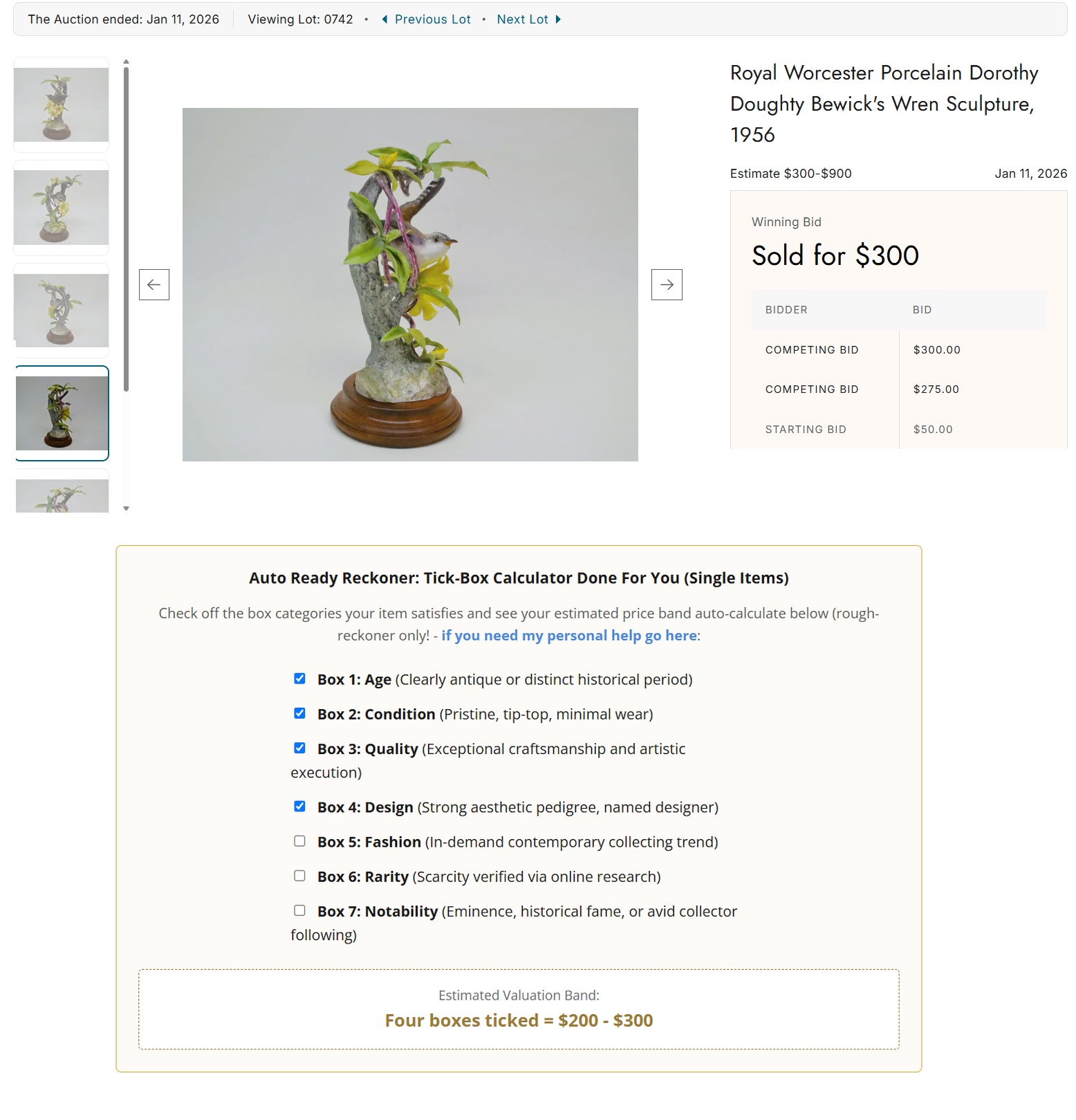
Example 4: $200-$300 (four boxes ticked)
 Photos from the Liveauctioneers.com database
Royal Worcester Wren - why four boxes ticked?
$300 hammer price for this item sits at the lower end of the auction estimate of $300-$900, yet it's at the upper estimate of the box tick ready reckoner. Why? Mainly because is box 5 were to be ticked (fashion), it would be right there in the auction prices band estimate. But fine china is not as fashionable in the 21st century as it was in the 20th. So the auctioneer was a tad optimistic maybe? The period is vintage (1950's), rather than antique, but it is a distinct nostalgia-producing era. The quality of Worcester production is widely known as is their historic place as England's first factory to emulate the mysterious porcelain of the Chinese 300 years ago. There is a named designer with a hand signature. As for the three boxes it doesn't tick - English bone china is no longer as fashionable as it was throughout the 20th C. Rarity: It is not a common piece, but it isn't a one off or impossible to get hold of if you look hard enough. Notability: Worcester is still highly regarded and collected, sure, but doesn't have a fanatical (avid) audience fighting over every auction bid. It is still 'production' rather than fine art.
Example 5: $300 - $1,000 (five boxes ticked)
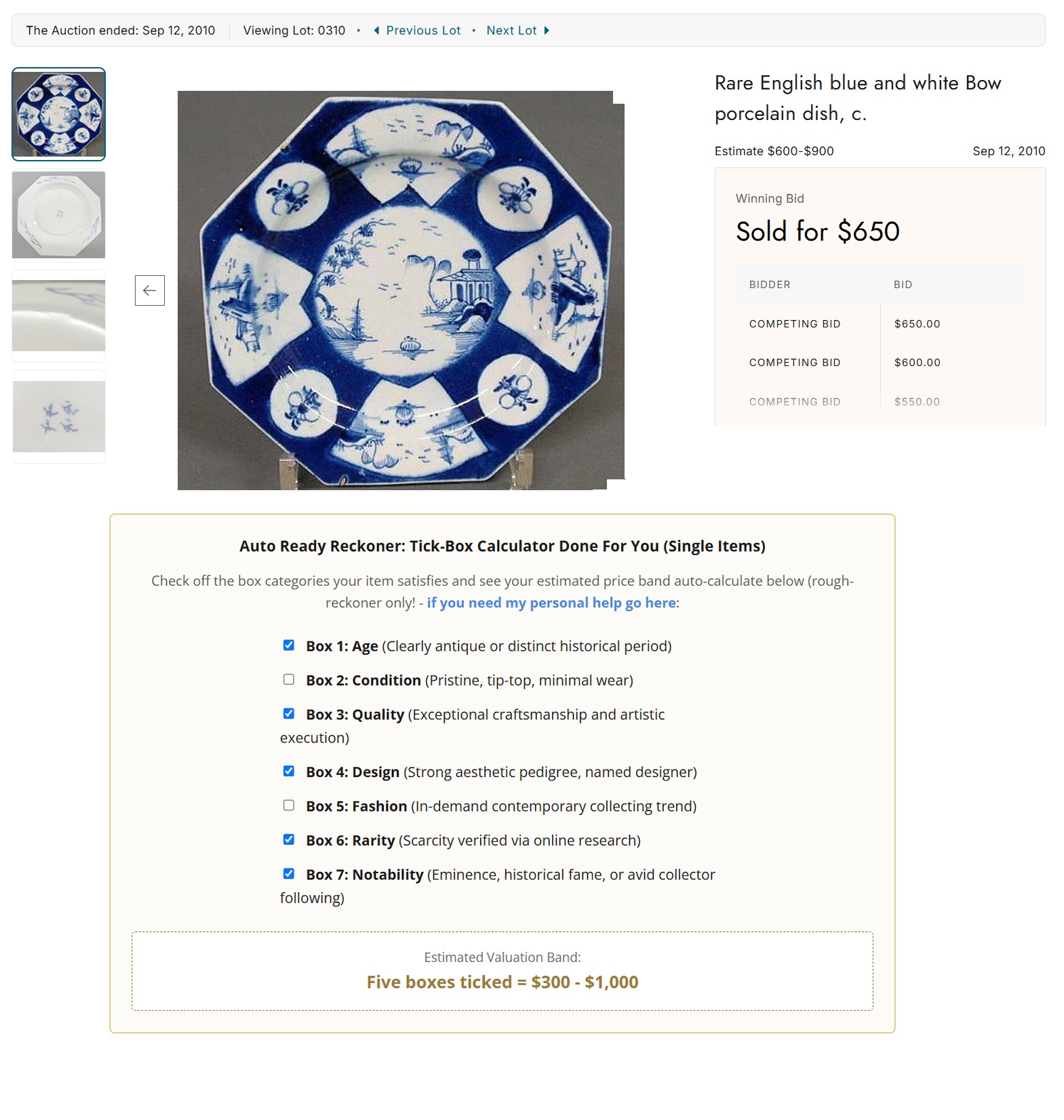 Photos from the Liveauctioneers.com database
Bow blue & white dish - why five boxes ticked?
The dish is from c.1760, is an amazing blue and white design and is by a rare and well known English maker of historical fame - Bow. We can't tick the condition box as it has a small visible chip. We can't tick the 'highly fashionable' box as there is no particular spiking trend for this type of item at present. There may be in the future, but not currently. So five out of seven and a hammer price of $650.
Example 6: $1000-$2000 (six boxes ticked)
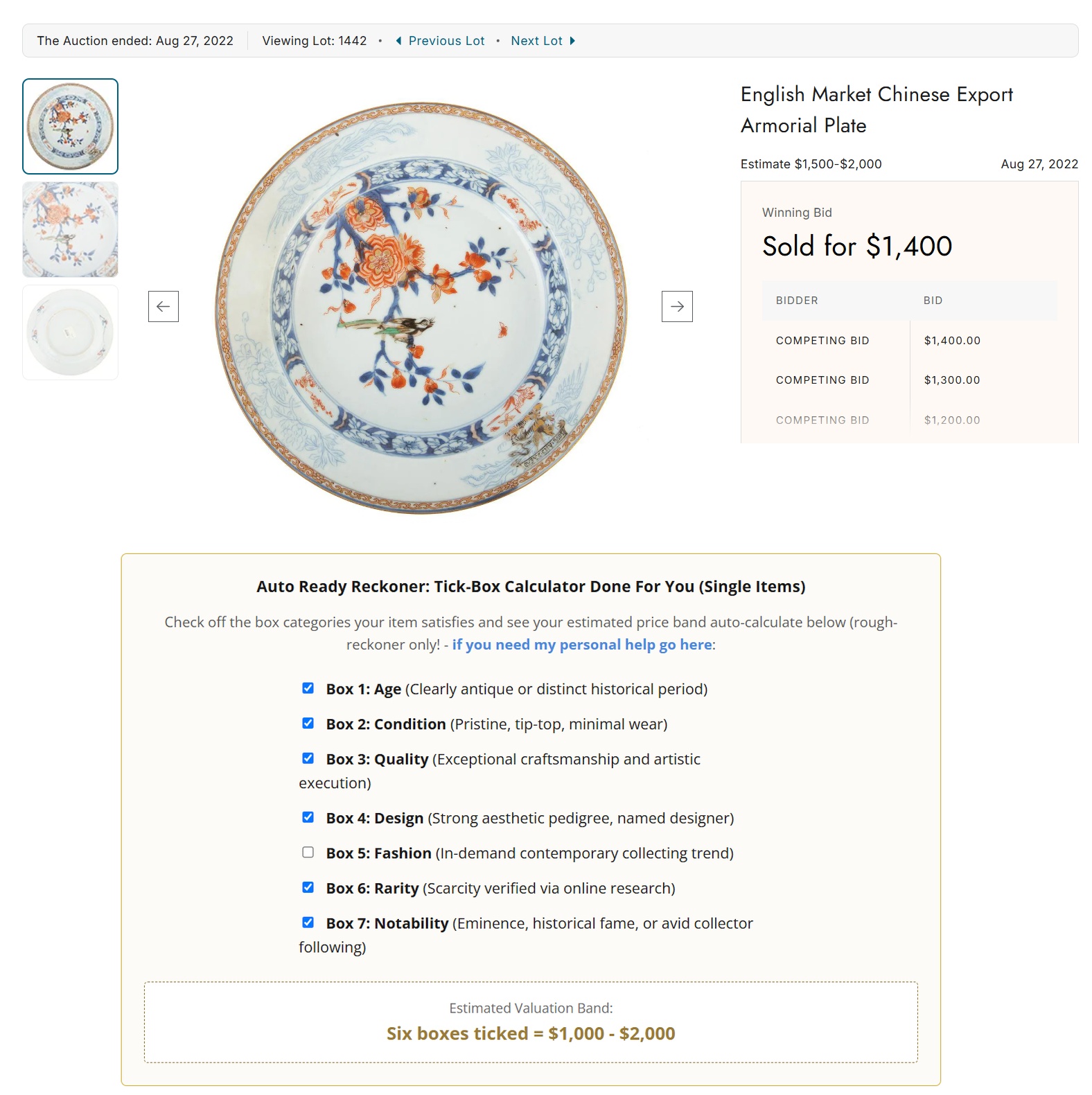 Photos from the Liveauctioneers.com database
Chinese armorial hand-painted plate - why six boxes ticked?
Sold for $1400, this "armorial porcelain" plate was custom-made c.1722 Chinese Imari palette export porcelain (ie the Chinese copying the Japanese Imari pattern in the Kangxi revival). These armorial plates were specially commissioned by wealthy European families to be painted with their specific family coat of arms (in this case, the arms of the "TOWER" family). So, all but one box ticked - that of the fashion element. The demand is steady but not currently spiking. It's the spiking of demand that ups the price that bit more into a different bracket - ie when people try to insanely out-compete each other at auction.
Example 7: $2000-$5000 (seven boxes ticked)
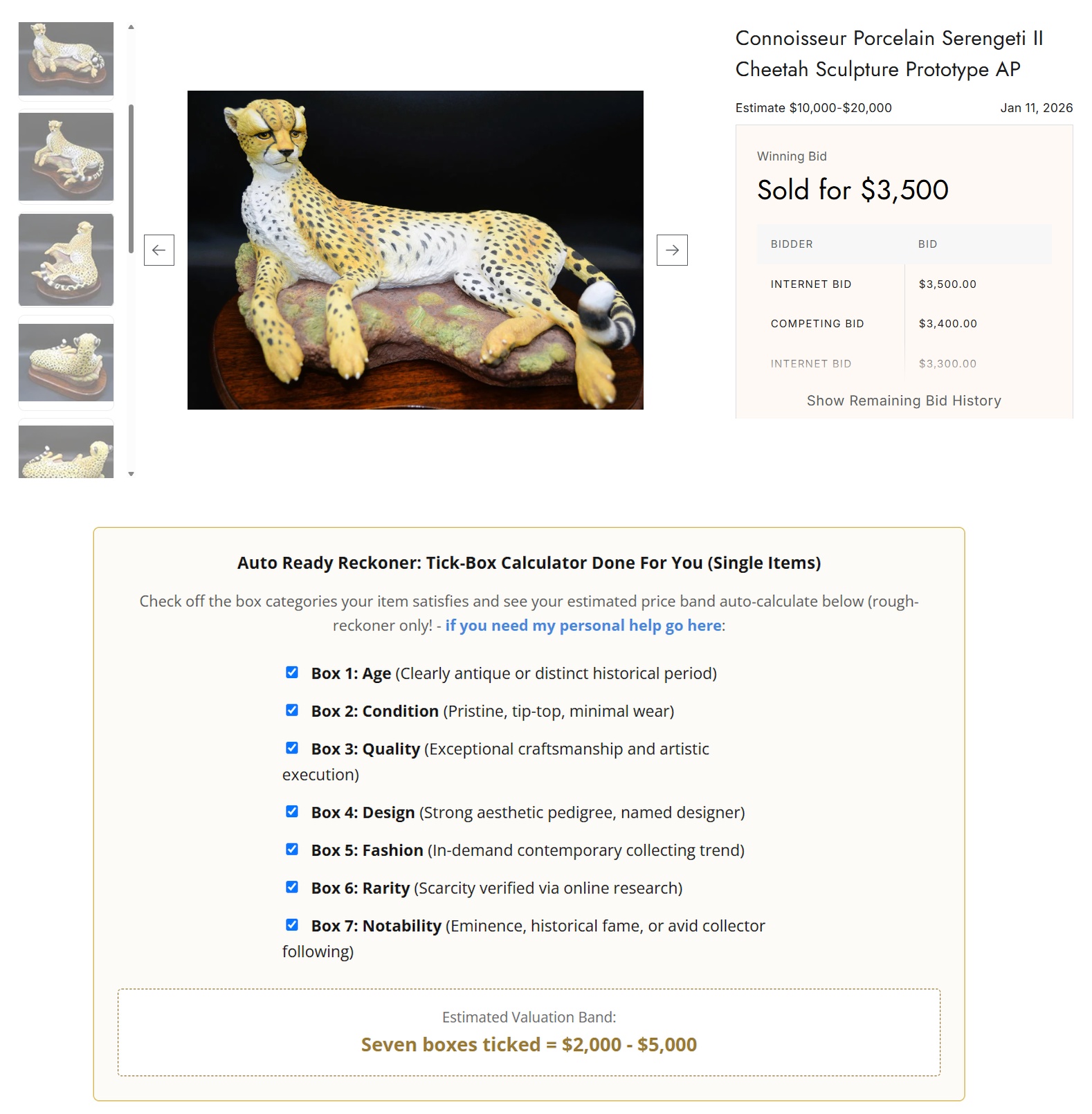 Photos from the Liveauctioneers.com database
Connoisseur Porcelain Studios Cheetah - why seven boxes ticked?
Sold for $3500 against an auctioneer's estimate of $10,000 - $20,000 is notable. I checked the price history of all Connoisseur Porcelain Studios sales on Liveauctioneers.com (link below), and the highest any piece has gone for is $5000 at auction. Yes, the retial price would likely be $10,000 - $20,000, but that includes the retail mark up. So the auctioneers were a bit on the optimistic side there.
This is a large bone china piece (10" high, 18" wide) - which is fraught with technical difficulty. It is from the renowned maker Connoisseur Porcelain Studios, legendary for pushing English bone china to a "Museum Quality" standard. Only 25 of this item ever made. Every single component is hand-created and it is completely hand-painted. Painting required weeks of specialized labor by master painters. Provenance is from the Archival Collection of Re Vann Galleries.
Although I have put an upper limit on this tool for all 7 boxes ticked at $5000, obviously, many items can exceed this, but these cases are rare outliers, and not within the remit of this website or practical reckoner tool.

5. Research it yourself: the auction and sold-price databases I use
 Are you suffering from GBO? (aka Google-Burn-Out!
Let’s be honest, formal appraisals cost money, and standing in a mile-long queue for a TV presenter with a bow tie isn't always practical when you just want to know what your inherited china is actually worth. The secret sauce of professional appraisers? They simply know (or look up) what an item historically fetches at auction. Thanks to the internet, and their hidden archives, you can do this too.
Going it alone on the value of antiques and vintage china identification requires commitment, and often entails GBO (Google Burn Out). To save you from this and endless forum posts asking "does anyone know what this is worth?", here is your shortcut map to the three main tiers of online auction databases:
🏛️ The Three Tiers of Auction Databases For the Value of Antiques (all antiques, including china)
Here is your shortcut map to researching values across the major online auction tiers:
1. The Luxury End (Sotheby’s, Christie’s, Bonhams & Barnebys)
- Best for: Prized art objects, rare high-end porcelain, and museum-quality display pieces.
- How to use it: Check sold listings of major houses or use Barnebys.co.uk as an aggregator for upmarket sales results. This helps establish what true quality looks like—and what it doesn't.
2. The Middle Sector (Liveauctioneers) — Your Sweet Spot
- Best for: Most vintage and antique china collections sitting in our cabinets and attics.
- How to use it: My go-to database for past sales records going back over a decade is Liveauctioneers.com. It acts as a massive hub for boutique and regional auction houses. It takes a bit of determination to dig through, but it is currently free to access.
3. The Popular Sector (EBTH)
- Best for: Everyday estate sale finds, common patterns, and popular-tier ceramics.
- How to use it: EBTH (Everything But The House) photographs and catalogs actual home contents, giving you a crystal-clear look at what items routinely fetch at online estate sales.
💡 Pro-Tip: How to "Speak Fluent Google" Without Losing Your Mind
If you type a vague phrase like "chinese vase blue & white", you'll drown in hundreds of irrelevant results. Instead, use smart search modifiers to narrow down the abyss:
- Use "OR" in capitals to cover variations in descriptions (e.g.,
vase hexagonal OR hexagon OR '6-sided' blue white). - Search inside specific sites using the
site:command so you don't have to click blindly through every page (e.g.,site:ebth.com "hexagonal" blue white vase).
Practice these quick tricks, trust your own instincts, and you'll quickly develop the 'nose' of an expert!
6. Mark identification websites to find out what you have in the first place
If you need help with identification before you can assess your item's value, scroll below to the sites that help us identify what we have. The point is, you first have to know what you have before you can evaluate it.
Here are the online websites you can use for identification research (often falling under the radar of the search engines. All of them have their faults, but they are great research assets:-
💡Gotheborg.com - Chinese, Japanese & Far East porcelain marks. A monster of a website - hats off to Mr Gotheborg.
Gotheborg's Chinese Pottery Detective Tip: The Qianlong Trap
Watch out for the incredibly common red square seal marks that say “Da Qing Qianlong Nian Zhi” (Great Qing Qianlong Period Make). While Emperor Qianlong reigned from 1736–1795, Gotheborg features excellent guides showing how these exact red stamps were mass-applied to 20th-century export pieces that are not actually from the historic Qianlong period!
💡Porcelainmarksandmore.com - German and East European porcelain marks - excellent site but uses navigation based on geographical location not maker’s name, so lacks simple alphabetical navigation (can be frustrating for this reason). Some of the main makers marks are only available to those who make a donation to the site - which is well worth it.
💡Collectorscircle.com - Bohemian (inc. Austrian/Vienna) & Czech china marks - great for eyeballing lots of pottery marks quickly – scroll down to look for a mark you're searching for (sip a cup of tea as you do so). (Note: The following links point to the hidden digital archive, as, sadly, the Ginni's site is no longer active.)
- Ginni's Bohemian China Intro & History – Read this first for regional factory timelines.
- Bohemian Pottery Marks Gallery: Part 1 – Early factory marks alphabetical index.
- Bohemian Pottery Marks Gallery: Part 2 – Covers major mid-era marks including Royal Dux, EPIAG, and Carl Knoll.
- Bohemian Pottery Marks Gallery: Part 3 – Deep-dive factory variations.
- Bohemian Pottery Marks Gallery: Part 4 – Essential guide for identifying historical New York Importers (like L. Straus & Sons or Ebeling & Reuss) who stamped their own marks over the Czech whitewares.
- Fakes and Frauds Part 1 - See if your item is an identified fake
- Fakes and Frauds Part 2
💡Efineantiques.com - This, again, is a single archive page of hundreds of pottery mark photos & factory info (the mark photos on this archive page may take a few minutes to load - be patient!). It was curated by professional appraisers Sharon and Jerry Dickinson but went offline years ago. I have retrieved their master directory from the vault. It's the Niagara Falls of all online information, and quite magnificent to an anorak like me looking to identify stuff so I can know the value of antiques.
🔍 Quick Checklist: The 10 Most Searched Makers on the Efineantiques.com Page
Sharon's archive covers over 200 marks, but these are the top 10 names from site visitors that contact me:
- Altrohlau (Hutschenreuther era): Essential for dating the complex "Eagle" and "CMHR" backstamps.
- Aich (Porcelain Factory Aich): Tracks prominent 19th-century Bohemian export wares and portrait sets.
- August Nowotný: Early, highly design-focused 1800s table porcelain and purple tea sets.
- Ditmar-Urbach AG: Famous for tracking collectible Art Deco and regional art pottery.
- EPIAG (OEPIAG): Deciphers the confusing "umbrella" marks used after multiple Czech factories merged in 1920.
- Franciscan (USA/England): High-volume everyday dinnerware, including the iconic Desert Rose pattern.
- Franconia (K & A Krautheim): A major guide for identifying delicate, gold-rimmed Bavarian estate china.
- Friedman Silver Co.: Tracks vintage Brooklyn-made silver and porcelain marks from 1908 to 1960.
- Royal Dux Bohemia: Crucial for spotting fakes and dating the famous applied pink clay triangle marks.
- W. Schiller & Son: Identifies the unique, incised "WS&S" stamps found on antique Majolica.
💡Oldandsold.com - Archived Resource: Old & Sold Historical Pottery & Porcelain Marks Directory - Preserved digital archive via the Internet Archive / Wayback Machine.
While heavily focused on rare, early historic markings, this sprawling vault contains invaluable chronologies for major European and global ceramic hubs.
These archive pages may take a few minutes to load - be patient!
- France (Archive) – Essential deep-dive for Sèvres date letters and hard/soft-paste porcelain marks, plus Limoges, Chantilly, Mennecy, and Rouen.
- Germany (Archive) – Covers Meissen crossed-swords variations, Dresden, Höchst, Nymphenburg, Frankenthal, and early Berlin (KPM).
- Great Britain: England, Scotland & Ireland (Archive) – Extensive index covering Staffordshire, Wedgwood, Bow, Chelsea, Worcester, Derby, Coalport, and Minton.
- China (Archive) – Imperial dynasty reign marks (Ming and Qing dynasties) and export porcelain backstamps.
- Japan (Archive) – Key historical marks for Imari, Arita, Satsuma, and Kutani wares.
- Italy (Archive) – Early Capodimonte (N crown variants), Doccia, Venetian porcelain, and historic Majolica centers.
- Denmark (Archive) – Focuses on Royal Copenhagen wave marks and Bing & Grøndahl backstamps.
- Holland (Archive) – Historical Delftware factory hatchet and monogram marks.
- United States (Archive) – Early American art pottery and china backstamps including Rookwood, Lenox, Bennington, and Willets.
- Belgium (Archive) – Tournai, Brussels, and Boch Frères.
- Russia (Archive) – Imperial Porcelain Factory (St. Petersburg) monograms and Gardner Moscow marks.
- Spain (Archive) – Buen Retiro, Alcora, and Hispano-Moresque faience.
- Sweden (Archive) – Marieberg and Rörstrand early markings.
- Switzerland (Archive) – Nyon and Zurich porcelain marks.
- Norway (Archive) – Herrebøe and early regional faience.
- Luxembourg (Archive) – Early Villeroy & Boch / Septfontaines marks.
- Portugal (Archive) – Vista Alegre and regional faience factories.
- Persia, Turkey, Syria & Poland (Archive) – Iznik ceramics, Persian lusterwares, and Korzec/Baranówka Polish porcelain.
7. Or just ask me: send photos for a free treasure-or-trash opinion
Want to know the value of antiques without having to faff with all this time-consuming research? If you have china items, send me your pics here - go to upload form and I'll have a quick look.
return from Value of Antiques to Figurines Sculpture Homepage or alternatively back to the hub page for this section Antique China Values