- Home
- Identify Pottery Marks
Pottery Marks Explained
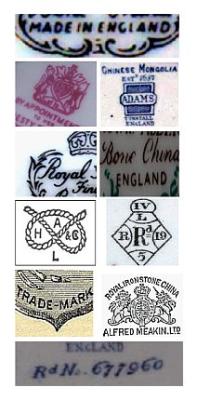
Whether its English pottery marks or German porcelain marks, Japanese vintage backstamps or Chinese seal marks, the abundance of unknown branding logos sometimes can seem like a frighteningly huge subject to tackle.
But never fear, your friendly online guide is here to help you through this maze of china marks! On this page there is a quick run-through of the basics of mark identification (it tells you how to look for clues to how these sometimes mad hieroglyphics work).
If you have a search around our China Chat posts, you will see we
specialise in helping people in identifying their mystery marks.
This special search box searches all the posts in a jiffy.....
Extra Help If Needed
Before we launch into this post about pottery marks, if your head's coming off, you're feeling dizzy, or suffering from GBO (GoogleBurnOut) and you just need some help, read this epic article I wrote about how to research your mystery china online and discover it's value .

Okay, back to how to research pottery marks.
Sleuthing is Where the Fun Lies
Together we have uncovered the origin of marks shown nowhere else online.
Our China Chat discussions are a place where we get the opportunity to contribute
together. The more of us
get involved, the knowledge base gradually expands. Since 2006 and counting.
Maybe we invented the 'social media' space for identifying pottery
marks. You (the site visitors) invented this system, not me. I just went
along with it and facilitated somewhere for us to store our knowledge!
Thank you all.
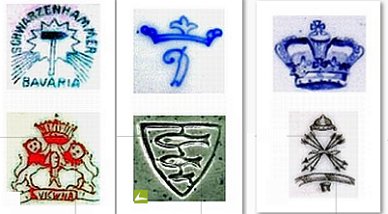
Some of the mystery marks we have been confronted with - and solved!
How It Works
The China Chat discussions are an easily searchable
online record of mystery pottery marks.
The visitor posts are divided into 8 different China Chat sections:-
1. China Chat featuring English marks
2. China Chat featuring German & Bohemian marks
3. China Chat featuring French marks
4. China Chat featuring Far East marks
5. China Chat featuring American & Canadian marks
6. China Chat featuring Russian & Eastern Europe marks
7. China Chat featuring Italy, Spain and Scandinavian marks
General Advice About Pottery Marks
Ok, let's start thinking about this logically.
How does research work in this space? Let's start with the big picture. This will help your thinking.
In terms of where your mystery marks come from, if it doesn't have Asian writing on it and it doesn't look like a Japanese mass produced item from the 1950's, the number one suspects for mystery marks are likely to be England and Germany - due to sheer volume of production from those countries over many generations.
German marks are perhaps the most difficult to track down and form the biggest section of mark identifications ...more
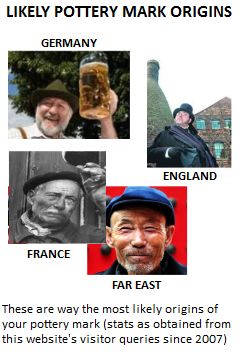
France, of course was a big player too, but we have many less queries about French china makers marks ....see exactly why here
American china making came into its own, developing from utilitarian to sophisticated bone china, with the Californian art pottery making a welcome jam in the sandwich. See more on the overall picture of the development of American pottery marks and the main companies involved here . . . more
The Clues Are Always There If You Know Where To Look
BUT! many of them are subtle, so you have to tune in......
For example, post-war Japanese export china often uses Western looking marks. On close inspection though the production often has giveaway clues of origin. More on Japanese and Chinese wares here....
|
"The very pottery marks on the bottom of a piece of rare crockery are able to throw me into a gibbering ecstasy" - Mark Twain
Continue reading below.... (↓) |
Trade Marks, Ltd and RN
The trade-marks act came in 1862 so if you see the words 'Trade Mark' (see above photo) think late Victorian.
Similarly, the word 'Limited', or 'Ltd' was not used until the 1860's or thereafter.
....Whereas, the letter 'R N' (which stand for 'Registered Number' - see above photo) was later and didn't start until the 1880's.
You see, so knowing your pottery marks is all about putting feelers out to pick up the subtle clues.

But What About Value?
Now, we had to separate out the 'valuation' aspects from the identification forums because they started to get messy and go off topic. Identification is one thing, valuations are quite another. Appraisals need an expert impartial eye with no question of a vested interest creeping in.
So for valuation requests (and that covers a lot of people) we had to invent a quicker (paid for) service
But Is My Stuff Worth Valuing?
For those not sure whether their items are worth the appraisal fee, I wrote a couple of different pages suggesting how you might do a bit of research on the value yourself first. You might have some fun with my free 'ready-reckoner price calculator'. I designed it in order to give you an idea of where your item might fit into a price range.
I also wrote a page giving a run-down of how you might use ebay and other resources to gauge the value of your stuff.
Also, at some point, you may want to go and have a quick look at this page:- Discovering the Value of Antiques which mentions good places both online and offline I often use to research items.
Valuation Self-Help! (help's at hand)
In reality, there are two jobs to do if you seriously need to put a value to your china set, both of which this website will help you with:
The first is to identify the specific pottery mark and once that is done, the second job is to get an idea of the value.
Use my China Manufacturers A to Z guide
here on this site should give you the key information you need about most notable makers. If not in this guide, there will probably information about them somewhere within the China Chat posts (just use the site search facility).
Further reading:
- My step-by-step flow diagram of how to go about pottery marks identification
- How to fast-track your id pottery mark report
- A website I find invaluable for researching Staffordshire makers and marks is one you might want to bookmark too: ww.thepotteries.org
Return from 'Pottery Marks' to the Homepage
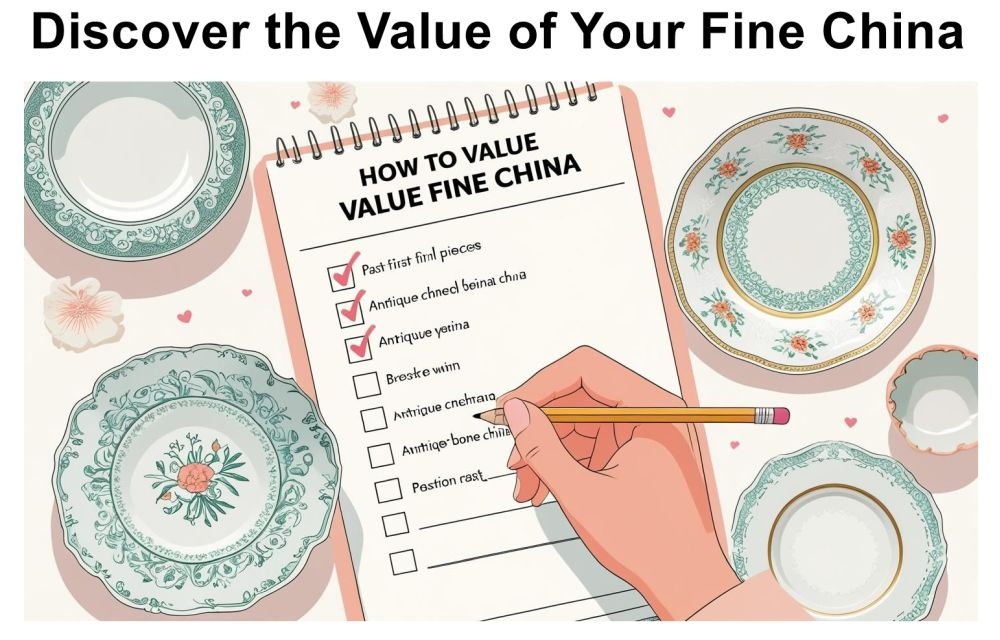
Inherited a china set?... Download my free 7-point checklist to instantly assess its potential value.
You might like these
Pottery and Porcelain Marks Discussion Forum
Join the pottery and porcelain marks discussion forums to help and be helped to identify your mystery markings and backstamps on your china
Chinese and Japanese Porcelain Marks - The Bigger Picture
Does my vase have Chinese or Japanese porcelain marks. Read this interesting infomation on how to know what 's what
Pottery & China Marks Page 5 of Visitor Queries Archive
This is the pottery & china marks identification forum archive page 5. A free-to-access record of solved or retired queries posted by visitors.
Pottery Identification Marks
Pottery identification marks page no. 4 of archive - feel free to browse or search the discussion forums where visitors from all over the world help each other solve mysterious backstamps
French Limoges and Sevres Marks
Here is an overview of exactly how to get to grips with your Limoges and Sevres marks
Pottery Marks Identification Made Easy
Pottery marks identification is made easy and fun with this one-stop interactive site.
Antique Pottery Marks - France Archive Page 3
Antique Pottery Marks - France Archive - a free to access online record
American Pottery Marks
American pottery marks are a fascinating area.
Pottery Markings Archive Page 2
This is the pottery markings archive page no. 2 of solved or retired user generated posts
China Chat Archives - Marks of Italy & Spain
The china chat archives for Italian and Spanish Pottery Marks
ID Pottery Mark Form - Identify Your Mystery Pottery Mark
ID pottery mark and solve your mystery using the fast track expert service.
The Identifying Pottery Marks Forum - Welcome
Identifying pottery marks is what this page is all about. We have a forum where you post your queries and get help to answer them




From the Studio
• Peter Holland Posters
• Sculpture Studio